
Tough times don’t last……Tough people do
The Global and Indian economy is undergoing disruption never seen before. The traditional rules are being rewritten in real time. Inflation cycles, interest rate changes, AI-driven productivity, and shifting global trade alliances are all happening at once.
The time is unpredictable and volatile. View the world through any lens you choose—political, geopolitical, economic, financial, military, technological, or climatic—and the picture that emerges is one of profound instability. It is as though the entire world has simultaneously concluded that the existing order is no longer sustainable, setting off a wave of disruption, experimentation, and consequences that few seem fully prepared to manage.
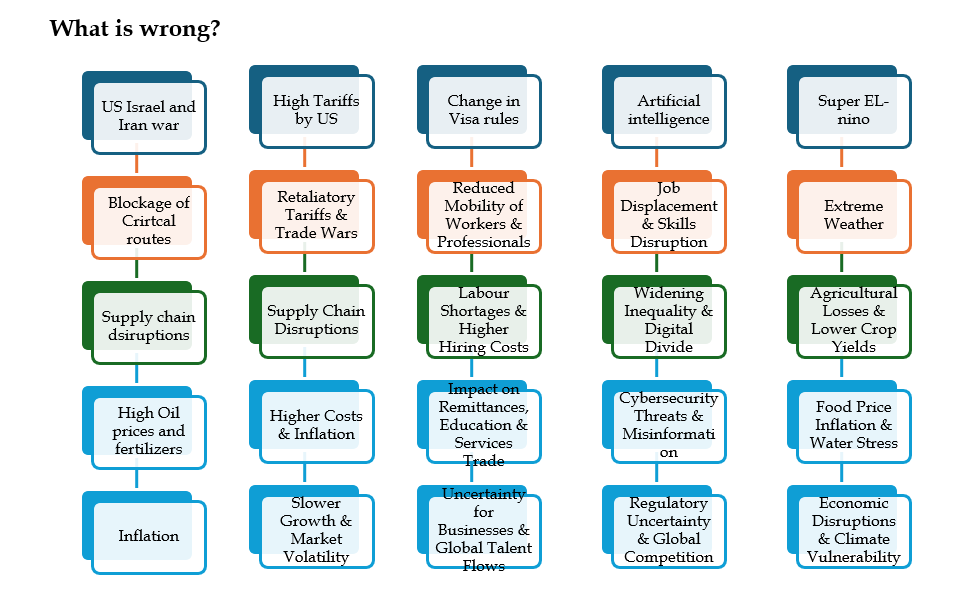
How is India Responding?
US-Israel-Iran war
Diplomacy: Focus on de-escalation and dialogue.
Strategic autonomy: Balanced foreign policy.
Evacuation: Safety of Indian nationals.
Energy security: Diversification of oil and gas imports.
Maritime security: Safe passage through critical routes.
Fuel availability: Ensuring domestic energy supplies.
Inflation control: Mitigating imported inflation.
Trade resilience: Alternative suppliers and shipping routes.
Export support: RELIEF scheme for exporters.
Crisis management: Inter-ministerial coordination.
Energy transition: Renewables and reduced import dependence.
High Tariffs by US
Trade negotiations: Bilateral trade agreement with the US.
Tariff relief: Negotiating lower duties on Indian exports.
Export support: Export Promotion Mission.
Credit assistance: Support for MSME exporters.
Market diversification: Expanding into alternative markets.
FTA strategy: Trade agreements with other economies.
Domestic demand: GST reforms to boost consumption.
Export diversification: Reducing dependence on the US market.
Manufacturing push: Make in India and PLI schemes.
Change in Visa Rule
Diplomatic engagement: Raised concerns with US authorities.
Alternative opportunities: Encouraged skilled professionals to explore domestic and other overseas markets.
Artificial intelligence
IndiaAI Mission: ₹10,372 crore to develop the AI ecosystem.
Indigenous AI models: Developing home-grown LLMs and Indian-language models.
Compute infrastructure: Affordable access to GPUs for startups and researchers.
AI skilling: Training students and building future-ready talent.
Deepfake regulation: Strengthening safeguards against AI-generated misinformation.
AI in governance: Applying AI to public services and administration.
Sectoral adoption: Promoting AI in healthcare, agriculture and education.
Cybersecurity: Strengthening safeguards against AI-enabled cyber threats.
Global cooperation: Participating in international AI governance initiatives.
El Nino
Advance preparedness: National and state-level contingency planning.
District action plans: Updated agricultural plans for vulnerable districts.
Crop diversification: Promotion of millets, pulses and low-water crops.
Climate-resilient seeds: Drought-tolerant and short-duration varieties.
Water conservation: Farm ponds, check dams and rainwater harvesting.
Efficient irrigation: Micro-irrigation under Per Drop More Crop.
Crop insurance: Wider coverage under PMFBY.
Farm credit: Kisan Credit Card access for vulnerable farmers.
Food security: Monitoring buffer stocks of rice and wheat.
Water security: Monitoring reservoirs and groundwater levels.
Livestock protection: Monitoring fodder and cattle-feed availability.
Price monitoring: Tracking food inflation and essential commodities.
Inter-ministerial coordination: Regular reviews involving the Centre and states.
How can we take advantage of this disruption and move unscathed?
While we cannot control the external environment, how we respond to it remains firmly within our control. From COVID-19 to global economic shocks, India’s experience highlights the importance of adaptive policymaking, domestic resilience and the ability to turn crises into opportunities. Every challenge brings a lesson, every crisis offers an opportunity to learn, and every experience prepares us to navigate the future with greater wisdom, resilience and foresight.
They can also create new markets for Indian MSMEs, encourage investment, generate employment and strengthen India’s economic resilience.
Opportunities arising from each global shock
US–Israel–Iran conflict
Renewable energy: Solar panels, batteries, inverters and energy-storage solutions.
Energy efficiency: MSMEs can supply energy-efficient motors, pumps, equipment and industrial solutions.
Domestic manufacturing: Opportunities in petrochemical alternatives and industrial components
Food and fertiliser alternatives: Biofertilisers, organic inputs and precision agriculture.
High US tariffs
Export diversification: MSMEs can explore markets in Europe, the Middle East, Africa and ASEAN.
Import substitution: Domestic firms can manufacture components and products previously sourced from overseas.
Value addition: Moving from raw materials to finished products can improve export earnings and competitiveness.
Changes in visa rules
Global capability centres (GCCs): India can attract more multinational operations, research centres and technology teams.
Remote services: IT, consulting, accounting, design and professional services can be delivered digitally from India.
Domestic talent retention: Indian companies can create higher-value jobs for skilled professionals.
Education and skilling: Demand can grow for specialised training, certification and industry-linked courses.
Start-ups: Indian entrepreneurs can develop solutions for global clients without requiring extensive physical mobility.
Artificial intelligence
AI for MSMEs: Affordable AI tools can automate accounting, customer service, inventory management and marketing.
Indian-language AI: Opportunities exist in translation, voice-based services and regional-language applications.
AI-enabled manufacturing: Predictive maintenance, quality control and production optimisation can reduce costs.
Cybersecurity: Demand can rise for data protection, fraud detection and AI-security services.
Employment and skills: New roles can emerge in AI implementation, data management, model evaluation and specialised training.
El Niño and climate-related disruptions
Climate-smart agriculture: Drought-resistant seeds, micro-irrigation, soil testing and precision farming.
Agri-tech: Weather forecasting, crop monitoring, farm advisory and digital marketplaces.
Water management: Rainwater harvesting, wastewater recycling and water-efficient equipment.
Food processing and storage: Cold chains, warehouses and food-preservation technologies can reduce post-harvest losses.
Climate-resilient infrastructure: Opportunities in resilient construction, drainage, flood management and disaster preparedness.
Conclusion
Every global crisis creates both risks and opportunities. For India, the challenge is to convert external disruptions into domestic capabilities—by promoting innovation, strengthening MSMEs, diversifying exports, accelerating the green transition and building resilient supply chains. If supported by finance, technology, skills and appropriate policies, these opportunities can generate employment, improve competitiveness and advance India's journey towards Viksit Bharat.

